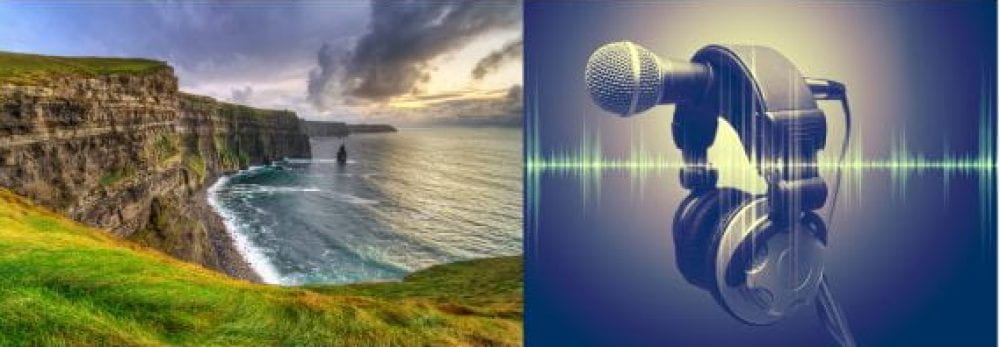
Ewe Herd it Here First

Sheep are an iconic part of Ireland’s image. Walk into any gift store and take a look at the hundreds of postcards, stuffed animals, or drinking glasses that feature these animals. Sheep line the shelves and adorn the hills, but what are they really doing in Ireland? We are Elena, Hashna, Mia, and Maya, and in Ewe Herd it Here First, we will take you through the reality of a small-scale sheep farm in West Kerry all the way to a local store that sells Kerry wool and talk about the future of these woolly animals.

Mia: When you picture Ireland, what do you see? Rocky cliffs plunging into breaking waves, rolling green hills, and of course,

*Sheep Bleat*

Sheep. Ireland’s gift shops are lined with sheep merchandise ranging from keychains to plushies to postcards. Clearly, sheep are an iconic part of Irish culture, but what do sheep really mean to Ireland today?

Elena: This is Ewe Herd It Here First, and we are Elena, Hashna, Mia, and Maya, and we are in County Kerry, Ireland on a UC Santa Cruz study abroad program. We’re exploring the culture and economics of the sheep farms that support the 114,305 sheep in County Kerry. 

*Sheep Bleats*

Maya: Those are the sheep at Dinny Galvin’s farm. They eye us cautiously as they realize we’re not going to feed them. Their cloud-like bodies begin to trot over to the gate the moment they spot Dinny.

Dinny Galvin:

So my name is Dinny Galvin, I’m a dairy and sheep farmer. I have 40 cows and we have 20 sheep. My dad bought a few sheep by accident on the market and brought them home and right away I fell in love with the sheep. I just wanted to keep the sheep and have a few baby lambs and that was it.

*Dog Barking*

Hashna: And this is Dan. He’s a border collie that Dinny uses to herd his cows and sheep. Dan is bringing the sheep in now so we can take a closer look. These sheep have shaggy white coats, curling horns, and faces like Rorschach inkblots. 

Elena: Dinny introduces us to his sheep as if he was asking us to meet members of his family. And in a sense, they are.

Dinny Galvin: Everybody’s different. You might think alike, but we’re all different. And so are the sheep. You’ve just gotta see it in them, that’s all.

Hashna: We were surprised to learn that Dinny doesn’t raise these sheep for their wool. In fact, their wool is somewhat of a financial burden to him, rather than a valuable product.

Dinny: It’s not so much about the wool, but it’s just that the value isn’t added to it.  A disgrace.Yeah. Um, there’s one big market in England, Bradford Market. That’s where they process and scour all the wool and clean it.  So we should be doing that locally here. We have a hundred tonne of wool comes into a place locally here. Yeah and it’s just packed into large bales and shipped to Bradford, UK.

If we were just scouring that, which is washing it, that would put money back into the farmer’s pockets because it’s not going halfway around the world to be washed. 

Mia: Wow, shipping wool all the way to England, that’s a hefty expense. And look around, most people are wearing synthetic fabrics. Even my sweater is acrylic. Wool just isn’thigh in demand anymore.

Maya: So If wool is such a burden, why raise sheep for wool? 

Dinny: I don’t think we’re raising sheep for wool anymore, but you’ve got to take it off them. You have to shear the sheep.  It’s just like getting a haircut.  

Mia: Ireland has lost 15,000 sheep farms since 1993. Dinny told us what would be lost from Irish culture if this trend continues

Dinny Galvin: You lose the rural communities. You lose rural people out of the countryside, you’re going to lose the school. You’re probably going to lose the sports, the GAA.

And you’re going to lose people in general, people to talk to. You know, that’s a big, big thing. Animals will provide you with a certain amount of company, but if you have nobody, if you haven’t another human being to talk to, it’s, you know, it’s not a good way to be. 

Elena: So wait, if these farms are shrinking and they don’t raise sheep for wool anymore, why are these shops full of wool products that claim to be locally sourced? 

Mia: Well Kerry Woolen Mills is a local shop and wool processing company that is one of only two working mills left in ireland. We talked to the manager of this shop to get a wool makers perspective

You walk in the small, square building and a rainbow of colors and textures greet you. Local wool products like hats, blankets, scarves, and yarn flood every shelf, clothes rack, and bin.

Grainne Garnain: My own name is Gráinne Gárnain and I manage Kerry Wool Mill Shop in Dingle. Kerry Wool Mills is a mill located about 40 km from Dingle itself and they have been producing wool for, well, since the 17th century. The current owners have had it in their family for about 110 years now. 

The Majority of what we source is, we would predominantly use Irish wool. Now you do get different textures through the shop purely because we use a mixture of lambs’ wool and then the Aran, the adult sheep.

Maya: Like Dinny, Gráinne emphasized the community in the wool industry.

Grainne Garnain: I mean they’re intertwined, all the working mills work together.

So even here we will stock Cushendale, we’ll stock Rosson. Because they’re like us. So the smaller mills, we do support each other. We are small working mills. So yeah, we work very, very closely with them

Mia: She also pointed out changes that she noticed.

Grainne Garnain: It’s changing even now. So in recent years, even in the last kind of five years, there’s a big push on education, both educating, I suppose the mills themselves and the farmers.

So, The price of the sheep fleece is low. That’s an argument that I mean, every farmer has, and often it will cost a farmer more to shear the sheep than what they’re getting for the fleece. So we are focusing on, I suppose, educating farmers that the better quality fleece is obviously going to produce a higher quality or a higher price.

On the flip side of it, there is only two working mills left in Ireland doing the full process. So really need a high standard. So, education all around will make a big difference.

Mia: We questioned her on what she saw for the future of wool, and she answered to us,

Grainne Garnain: I see Irish wool making a big comeback, to be honest. I mean, there is a major focus on it now, and it’s a fantastic raw material.

Like, it’ll keep you warm, it’ll help keep you cool. It’s self cleaning, which is always nice. It’s a really long, durable product. And the fact that it’s sustainable, renewable, It’s kind of a no brainer. So there is a lot of focus on mattresses, insulation now being used with the Irish wool. There is definitely more to be done with the Irish wool, and I reckon insulation is probably the way to go.

Mia: Wait, insulation? Like, using it in walls?

Elena: Yeah, Dinny mentioned this as well! He was talking to us about his hope for the future of sheep farming.

Dinny Galvin: Try to get something done with the wool–probably insulation. We need to build a pile of homes. Wool is biodegradable. Synthetic insulation isn’t a good thing, because if your house is remodeled or knocked that goes back into landfill, and the synthetic stuff doesn’t break down.

Maya: – Wool holds the story of a way of life in County Kerry. People here have grown up surrounded by sheep for thousands of years. For some, it’s an emotional and tactile connection to family.

Grainne Garnain: As a kid, I remember my grandmother knitting for me. I remember sitting down and being taught how to knit, and you were an absolute failure if you couldn’t master it. And I do, I see it too, I do it with my own girls. I have them knitting and sewing, and they’re using the Irish wool, and I suppose the biggest thing for me is as a child living in a rural place you grow up with sheep and you’re surrounded by them and you never have an appreciation for what they give you.

Hashna: Times are changing. The old way of life is becoming more and more distant. But many sheep farmers in Kerry, like Dinny Galvin, are trying to change with the times in order to keep their traditions alive.

Elena: So what is the future of sheep farming in Kerry? No one has a crystal ball, but it likely involves innovation and keeping products local. And Ewe Herd it Here First! We are Hashna, Mia, Maya, and Elena, and we are with UCSC in Kerry, Ireland. Thank you for listening!​


Dingle Hub: Dinny Galvin Website: Link

Kerry Woolen Mills Website: Link

Pub Investigators Look Into Two Top Irish Pubs

A group of three students have been searching for the truth behind what entices people to enter Kennedys and The Dingle Pub. These two pubs attract many locals and tourists, so what makes these two pubs similar, and what makes them different?

Made and produced by: Ainsley Clancy, Consuelo Mendoza, and Jason Mack

Dinny in Dingle

Ireland’s history is deeply rooted in agriculture, with livestock being the central focus of all those green fields you see when you arrive. Old practices of running a family dairy are under pressure from environmental laws and a rethinking of what is sustainable, but in other ways some of these ancient practices are being revived as more sustainable. Farmers feel caught in the middle. Ireland is a small contributor to climate change overall, but the efforts to reduce emissions may force consolidation and threaten family farms livelihood. Change is coming so fast from government regulations that farmers are wondering if they can hang on even one more generation. No matter how hard one farmer tries to change, he doesn’t feel like his concerns and livelihood matter in the bigger picture of government regulations. Dairy farming is trying to adapt, but the speed of change may be the death knell for this type of family farm.

Join us as we discuss the future of farming with Dinny Galvin, a farmer from the Dingle Peninsula!

What’s The Catch?

DESCRIPTION:

In the small town of Dingle Ireland, there is a local family-run business called the Fish Box. Locals and tourists alike line up down the street to get a taste of their fish. Only five years old, this restaurant is a huge success, but what’s the catch?

Today we dive into the issues in the fishing industry in Dingle and Ireland as a whole. We take a closer look at the Fish Box and how they manage to stay afloat despite rising prices, increasingly expensive fuel, biased restrictions, and sustainability struggles. With the help of special guest, Micheal Flannary, we get an inside look into what it’s like to be an Irish fisherman today.

THE FISH BOX / FLANNERY'S SEAFOOD BAR, Dingle - Menu, Prices & Restaurant Reviews - Tripadvisor


SCRIPT:


Music


CHRISSY: I just want to know, do you know where your fish comes from?


FISH BOX CUSTOMER: the Atlantic Ocean


CHRISSY: That’s a customer at the Fish Box, a family-owned restaurant in Dingle, Ireland where we: Chrissy, Nolan, and Eva are spending five weeks exploring the local culture and history of this small seaside town. Did I mention there is always a line out the door of this tiny venue? All seems rosy, right? However, recent changes in the fishing industry have led to increased prices of our favorite fishy dishes and changes in where our fish comes from, how it’s prepared, and who is preparing them. You might stop to think twice about spending a few extra for your fish, but have you thought about why you need to?  


Boat Noise                                                                                                                                                                                                                                                                                                                                                                                                                                                                                    


Something is happening behind the scenes, something… fishy. I’m Chrissy, I’m Nolan, and I’m Eva, and we are here to fish out the answers to this fishery mystery with the help of a local Dingle business focused on sustainability and quality fish.


MICHEAL: My name is Micheal Flannery. I’m the owner of the Fish Box. I own it with my father and my brother.


EVA: Micheal founded Fish Box in 2018. It’s a small restaurant. Locals and tourists are often seen lined up down the street outside the bright blue building, waiting to get a taste of the award-winning fish. When you go to the fish box you can expect to get the freshest fish available because they catch it themselves.


MICHEAL: The fish box started out quite small to be honest, and just kind of evolved.


NOLAN: The restaurant evolved from a wholesale outlet market to an actual restaurant in response to changes in the Atlantic fishery. Because of a multitude of problems, the profitability in solely fishing was waning, leaving Micheal to figure out how to keep the family business afloat.


MICHEAL: Like, you know, a big thing that, like my grandfather, my father always says, it’s called fishing, not catching. It means that no day is ever the same. It’s always different. And that’s important to remember that just cause you’ve one good day doesn’t mean the next day’s gonna be good.


NOLAN: Micheal’s dad has been a commercial fisherman for the last 50 years and the family’s fishing history is much older, going back 100 years. But as the 21st century began, things began looking grim. 


MICHEAL: We were finding it very hard to find a market for our fish, and we just felt that the kind of quality of the produce that we were bringing in wasn’t getting the value that it should have been getting. 


NOLAN: And so, Micheal opened the Fish Box, a family-run restaurant that catches, prepares, and serves its own fish. But while they were no longer worried about selling their fish to processors, they ran into new problems. 


MICHEAL: the problem is in Ireland, we just don’t have enough quota.


EVA: In Ireland, the fishermen only have a certain amount of fish they can catch each month. In order to sustain their businesses, they have to catch all their fish in 30 days, but its not that easy. 


MICHEAL: if you get 20 days bad weather, you only got 10 days to catch a fish and makes it very dangerous.


EVA: Not only dangerous, but catch quotas limit the number of fish boats are allowed to catch. 


MICHEAL: Yeah, so in Ireland we get a pretty raw deal with the fishing industry. I think we have a really large percentage of the waters and probably have the richest waters in Europe, but we have the minimum quotas here, which makes it really, really, really hard for the fishermen. 


EVA: But these quotas aren’t the same for other European countries that fish in Ireland, leading to a situation that can only be seen as unfair to the local fishermen. 


MICHEAL: You know, there’s plenty fish. There’s so much fish. There’s Spanish boats, there’s French boats, there’s Belgian boats, there’s every kind of boats fishing and harvesting. So like maybe five, six times more than what we can take outta the sea, which I just think is wrong, like, and other than being a fish fishing nation with built on fishing and farming, I think that it should be more self reliant on what it has.


EVA: There are other problems faced by Irish fishermen aswell. [Mee – hall] tells us there is an reduction in the Irish fleet, and the boats they do have are getting old. On top of that, there is a rising cost in the fuel needed for the boats. 


MICHEAL: They just brought on a decommissioning scheme and there’s been around 40 boats taken out of it, but all from the same sector are whitefish. All from whitefish, so that means there’s 40. That’s both supplying the restaurants this year. Of Ireland has put the restaurants in a really sticky predicament because we’ve already gone up on oil, gas and electricity, but now our fish is going up.


EVA: With rising costs of fuel and labor, the restaurant industry as a whole is dealing with higher prices that carry over to their consumers. So, many people are now simply choosing to cook for themselves rather than going out taking a chunk out of the livelihoods for these local businesses.


NOLAN: Micheal says that the government isn’t providing enough support to sustain the local trade of fishing. He proposes that the Irish government must work with the EU to increase the funding towards fishing in Ireland and help fishermen get back into full swing by increasing quotas. The first step would be by repairing or replacing old boats and giving local fishermen more power over local waters. 


Ocean Waves


MICHEAL: There’s an area that we fish on the parking point Bank West, about 180 miles west of Dingle.


That’s our main fishing area. We can only fish there five months of the year. What do we do for the other seven? when we are not fishing there, there’s English boats fishing there, there’s Spanish boats fishing there.


Why are they allowed to fish there? And we are not. It’s in our waters. It’s wrong. It’s totally wrong. So instead of us being 180 miles, Away from home and landing at home all the time. We’re 400 miles away landing into different ports. And these, these are men they’re coming home. They don’t see their kids.


CHRISSY: Today, its not just the weather fishermen are worried about, but also the law. 


NOLAN: A few months ago, the fishermen with the restaurant had a run in with the law. They had been in waters designated for prawn fishing where the cutoff day was November first. While there, they made the decision that after prawn season was over they would swap to bigger nets to catch white fish. They called the proper authorities who granted them permission, as long as their yield of prawns was less than five percent. While fishing they were flagged down, searched and detained by the navy, despite their catch yielding only 3 percent. They were held for several days without a charge until the final day where they came up with a charge that Micheal says most people consider to be made up. With this charge their boat is now frequently stopped by authorities, impeding their ability to catch fish.


MICHEAL: I just think that they criminalize it a lot. 


So just for an example now, I think there’s nine fishery patrol officers in Dingle and there is uh, 1, 2, 3, 4, 5, 6 ports. Yeah, which is just crazy. It’s just really hard to make an ends meet at the moment with it. Between weather and just everything, it’s tough. It’s a tough, tough gig. This isn’t, 50 years ago, all of the men now are qualified people. They all have high skippers tickets, they all have education. They’re intelligent men. They should know what’s going on.


I think at the moment the fishing is actually on the fence. And I think it’s nearly at the point of no return, where it’s gonna be too far for them to come back. And if they lose it, they’re in serious trouble because they’ll never get it back.


I don’t know what’s going to happen. It’ll be interesting to see does our quota increase, because if it doesn’t, there’s something very wrong and it’ll be there for the world to see. So I hope they do something. 


CHRISSY: Still, tourists and locals alike line up for a chance to taste the Fishbox’s fish, ranking the restaurant high on the travel guide’s best places to eat. The Flannarys plan on expanding the number of seats to 100, so although things seem dire, they are still planning for a future that includes fresh, locally caught fish, from sea to plate in a few, difficult steps. 


music


END.

Dating in Dingle: A UCSC Production

Dating is a highly complex part of any town’s culture. This podcast explores all the insides and outs of what Dingle locals feel dating entails in this charming town. From personal experiences to generalized opinions, let’s get into dating in Dingle. 

Written by Zuni Ruth, Keira Meyers, and Marie Palencia

Tidy Town Competition: A race for aesthetics

Have you ever heard of the ‘Tidy Town Competition’? When we tried to find locals to interview, they hadn’t either! The fishing town of Dingle on Ireland’s west coast, with its colorful and ornate buildings, attracts tourists from far and wide. But did you know that behind the scenes, a nationwide competition plays a significant role in shaping the aesthetics of these small towns? Join us as we explore the impact of Ireland’s Tidy Town Competition. Does it place undue burdens on these charming communities or is it a necessary pursuit of beauty and pride?


Druid in Dingle

Druids in Dingle

When you’re sick the easiest solution may feel like just taking a pill, but what if there was a better solution? Join us in the seaside town of Dingle, Ireland, as we visit with Julie Malone, the Dingle Druid, and explore ancient ancestral practices of Druidism. From an herbal walk to a class ritual, discover more about the traditions of connecting with the Earth and oneself here in Ireland.